Case Studies in an Inter/Multicultural World
Blog #11 The challenges associated with Muslim assimilation into Western society
BY Kody Gustafson
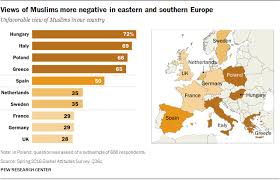
- 1. (A) To begin the experience of the Muslim youth in Europe is one that is unlike any other. Our first reading on Muslim Youth in Europe by Peter Mandaville goes on to describe this unique experience and highlights how it differs from those who grow up in a place that has a Muslim majority. One unique experience is the fact that much of the Muslim youth is torn between two different cultures. Their parents have instilled their Muslim culture on the children, however the children are also growing up surrounded by western culture. This is even more prevalent for Muslim children who attend public schools because they are constantly surrounded by western values. These children are seen as “others” in the eyes of many Europeans and this has an effect on their ability to find their identity. Many Muslims have struggled to find a way to fit in while still retaining their culture. While in a country that has a Muslim majority public displays of religion are common place and seen as normal. This is not the case in Europe as many have come to see public displays of Islam as being a threat to tradition. This intolerance towards Muslims has had two very opposite effects. One effect is that it has made the Muslim youth rebel against Islam and their parents leaving them more marginalized than before. They are not openly welcomed into western society and now that they have rebelled against Islam they are left somewhere in the middle lacking identity. Another effect that intolerance against Muslims has had is that it has pushed some to become even more rigid in their beliefs. This pushes them farther away from assimilating into western society and has given those who are against having Muslims in Europe another thing to point to as to why Islam is not compatible with western values. The youth has been alienated and rejected by many and left them questioning where they belong. The Muslim youth has also struggled with differing views than their parents. Some of the Muslim youth have come to see the older generation as still trying to live as if they were in the homeland. However, for the youth they have come to terms with the fact that they will have to practice Islam as the minority. Some have come to see Islam as being a defining aspect of what makes them different. Even when a youth pushes back against Islam they are still unable to escape their Muslim background.
- 4. (B) The second article by Sajan Decoding Europe’s Homegrown Terrorism is a very interesting piece which further discusses the challenges associated with Islam in Europe. One of the key things I took from the article is that rather than trying to understand what is wrong with individual terrorists, many people would rather point to what is wrong with Islam. Due to various terror attacks many Europeans have come to believe that a successful multicultural society is almost impossible with a large Muslim population. I believe it is dangerous when people begin to link an independent terrorist attack with the Muslim community at large and only further creates problems within society. The Muslim youth has been marginalized and as seen in the previous reading it has pushed some to become more radical in their religious beliefs. Sajan goes on to explain how some Europeans are quick to blame terrorism on Muslims but it is through their unwillingness to blend Muslim and western culture together that these people are pushed to these acts of violence. The Muslim community and western values are more in line than many people like to think. The article mentions various studies that show how compatible the Muslim way of life is with western values such as a strong belief in democracy. I do believe that through marginalizing the Muslim youth we have created a situation in which pushes them towards radicalism based on false religious ideals.
- 7. (C) Chapter 8 of The No-Nonsense Guide to Islam goes on to describe Sharia Law, its history, and how it is used today. I don’t believe Islamic law has always been consumed with punishment. The word Sharia has come to mean in religious terms as being “the highway of good life” and I believe that at its core it has legitimate components. I believe certain Muslim rulers have been consumed with punishment and have twisted the true nature of Islamic law. At times when the Muslim world was occupied with imperialism, Islamic law was used to justify rule. I believe Islamic rule was established to help believers live a life devoted to God. This concept has been manipulated over time and can’t be taken as divine.
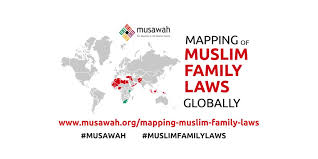
- 8. (D) The Musawah (Arabic for equality) organization is focused on creating equality and justice for all in the Muslim community. They are actively working to achieve equality and justice while stopping discrimination and treating others with dignity. The organization has also done much to work towards equality for Muslim women in society. These efforts towards the advancement of human rights have been made both locally and internationally. They are focused on sharing their knowledge across the globe and giving people an avenue to connect with other like-minded people. I firmly believe this organization can make a change and their current work has been able to advance the rights of Muslim women. The site was easy to navigate and their overall goal is to “We hold the principles of Islam to be a source of justice, equality, fairness and dignity for all human beings. We declare that equality and justice are necessary and possible in family laws and practices in Muslim countries and communities. “ making them a valuable resource.
- Resources
http://www.thehindubusinessline.com/opinion/decoding-europes-homegrown-terror/article9718569.ece
Sardar and Davies. The No-Nonsense Guide to Islam
Chapter 8 Contemporary Issues
Blog # 9 Exploring Islam, and moving past stereotypes
By Kody Gustafson
The first reading from this week concerned myths about Muslims and in particular those living in Europe. Justin Vaisse lays out four myths in his article that must be addressed in order to deal with the real challenges currently facing Europe. The first myth he discusses is that being Muslim “constitutes a fixed identity” in the eyes of other non-Muslim people. Furthermore, this means that rather than looking at someone’s social class, nationality, or gender they are characterized by their Muslim faith. They use the Muslim community as a whole as a scapegoat for other problems. Another myth he goes on to discuss is the idea that Muslims in Europe are in a sense foreign and “alien” to the native culture. This is simply not true and for centuries European culture has been in ways influenced by Muslim culture. For example, “the approximately 15 to 17 million persons of Muslim background currently in the EU-27 countries (population: 500 million) include both citizens and non-citizens of European member states, but a majority of them hold French, British, German, etc. nationality” this highlights the integration of Muslim people into the European sphere.
One reason it is important to make a distinction between the religious and political dimensions of Islam is that the political dimension is not always representative of the actual religious core. One important point to be made is that Sharia Law owes very little to the Quran and cant be taken as divine. Some Muslim rulers have departed from what the Quran says and one must differentiate between what the fait says and what the government does. Another important point is that authoritarian regimes who claim their version of Islam as absolute truth deny manifest diversity of plurality of Islam. These regimes make their own rules and their actions are not always representative of the faith.
I found the TED talk by Mustafa Akyol to be very interesting and informative. He does a great job of explaining how the worlds general idea of the Islamic faith is too focused on tradition and not enough on its core beliefs. It is important that we don’t generalize a problem created by extremists to the entire Muslim community because it is not reflective of the group at large. One of his main points is that many problems people associate with Islam are a product of tradition and how a ruling body used select facets of Islam to justify their model of ruling. One example is the seclusion of women in certain Muslim cultures which is not mentioned in the Quran but rather adopted by a ruling party. Another one of his main points was that political culture is the real problem not Islam. Non-Muslim governments point to the past and highlight examples of how Muslim led governments have been oppressive and used faith as justification for some of their practices. This is unfair because as time goes on different people take control of government and just because one regime misinterpreted the Quran doesn’t mean the next one will. Another point he makes is that one reason relations between Europe and the middle East have been tense is due to colonialism. European colonialism has led to resentment from the Middle Eastern community and made many become more stringent in their beliefs.
Another topic discussed in this week’s readings was that of what is Islam and who is a Muslim. Islam is a monotheistic religion and to be a part of this faith one must believe that “There is no God but God, and prophet Muhammad is the messenger of the God” and do so freely and sincerely. Islam affirms belief in one God who is all powerful and the absolute creator. One important tenant of Islam is that it rejects the idea that God intervenes in human form in history. There are three pillars of the Muslim faith and the first the Shahadah which is a call to prayer every day. The second is salat or prayer which should be done five times a day. The third pillar is that Muslims shall partake in fasting during Ramadan. To believe in Islam is to believe in the unity of God, believe in the prophethood of Muhammad and the messages of guidance he received, and believe in life after death and accountability on the day of judgement. A Muslim is someone who is logical and farsighted and is constantly aware of God’s presence in our everyday lives. A Muslim believes that the only explanation of all the wonder in the universe is that a creator exists.
The final reading discussed orientalism and the ramifications it has. Orientalism is a way of describing, representing, and controlling Islam. The term was coined by professor Said from Columbia university. However, Said may have coined the term but it has been used throughout history. Orientalism changed the way we view and study the Middle East and how we come to understand these “strangers”. One of the main points from the video with professor said is that the way we acquire knowledge about the orient is not innocent or objective, but rather has been influenced by certain motives and interests. For many years now, the West has formed views of the orient in a way that has distorted the reality of these places. It has served as a way for the Christian world to deal with the “problems” that Islam presents. It has served as justification for colonialism and a way for the West to have authority over the orient. A modern-day example of orientalism can be the stigma surrounding immigration on the southern U.S border. Immigrants have been painted as killers, drug dealers, and rapists so that the government can control who is being let in. They have been unfairly generalized and created a negative stigma around immigrants.
Sardar, Ziauddin, and Robin Yassin-Kassab. The Idea of Islam. C Hurst & Co, 2012.
Hunter, Shireen. Islam, Europes Second Religion: the New Social, Cultural, and Political Landscape. Praeger, 2002.
Vaïsse, Justin. “Muslims in Europe: A Short Introduction.” Brookings, Brookings, 28 July 2016, www.brookings.edu/research/muslims-in-europe-a-short-introduction/.
Post #12
Group A, Question 1: A lot of Muslim youth feel ostracized, unwanted, and depraved socially. Despite the multiculturalism in places like France and Germany, both countries haven’t done a great job of bringing their two largest cultures together. As a result, Muslims, of any generation, often feel like they don’t belong, and are often vulnerable…
Blog #10 From the journey to establishing a home in Europe, refugees face uncertainty the entire way
By: Kody Gustafson To begin I will discuss how Zemni and Parker explain the “failure of integration” of Muslims in Europe. One reason Muslims have been unable to integrate within European society is because many Europeans have come to view Islam as being anti-Europe. Through processes such as orientalism people have unjustly painted Islam and…
Follow My Blog
Get new content delivered directly to your inbox.

