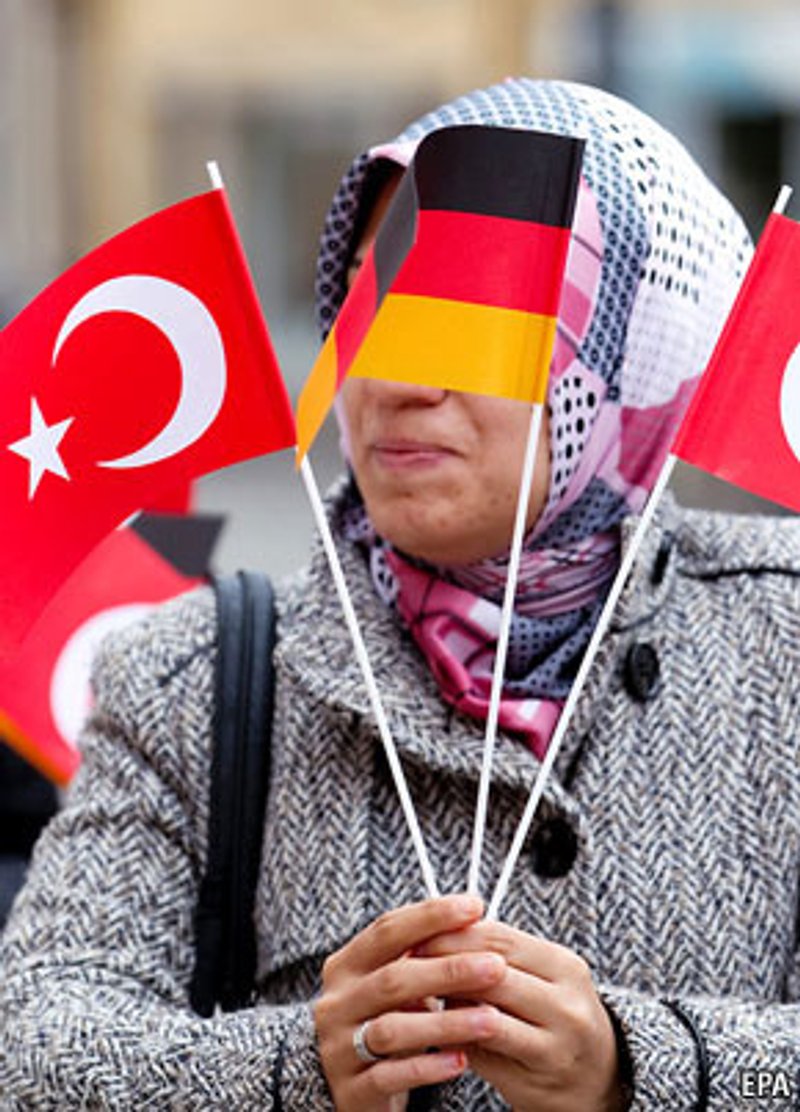
- Zemni and Parker give a few reasons for the “failure of integration” of Muslims in Europe. For one, the EU seems to have always had a problem with values and customs that don’t match a Judeo-Christian way of life, just on a fundamental basis. Those fundamentals may very well be exaggerated in the minds of the citizens and seated officials because the building blocks of Muslim life aren’t far from that of Jews or Christians, but their customs tend to look notably different on a surface level. And in the mid-1980s, they cite an instance where observers considered the idea of “the realities of a multicultural Europe” in a challenging light, as opposed to a positive addition of another culture to the community. This is ignorant and unprogressive, but kind of understandable. The whole EU was largely comprised of the people who, for the most part, weren’t clashing cultures. There were plenty of different states that surely had certain amounts of diversity but, overall, were easy to meld together and still make a cohesive group. Islamic people are strong in their values and it only makes sense for them to be off put by a culture that doesn’t look familiar beyond basic societal structures, and in some cases not even that. Diversity is a good thing all the way around, but it only makes sense that it brings challenges. It’s just unfortunate that to this day, Turkey hasn’t been accepted by the EU out of xenophobia for a people that are basically next door. Sounds pretty familiar actually.
- It doesn’t seem like Islam plays a role in any of this. The most practice of Islam I’ve seen in the entire series of content about refugees is how religious the people are. More than anything else, this all just seems like a nightmare that’s going on in their region right now that none of the players in the material could’ve helped. If I’m being honest, I didn’t have much of a thought about the foreign policy. It was hard for me to read on my browser, the text was pretty small and when I zoomed in it was blurry. I muscled through it for the sake of the comic, though, which was a really special read. I like seeing comics from true stories like that and that one was less intense and more suspenseful. The stakes were high but they didn’t seem to be in much danger, which was comparatively nice when you see the fear in everyone’s eyes in My Escape. But before I talk about the film, I thought the comic did a great job of portraying to the reader all the hoops that refugees have to jump through, especially reading this as a clueless American. I figured it wasn’t a simple process, but never-ending uncertainty is what really makes you sweat as you read the material. I was sweating 10x harder when I was watching the film though. The fact that their homes used to be so nice, and the guys at the beginning were just musicians, not even impoverished or anything. Everybody who lived happily and comfortably just a short time before ended up at the hands of smugglers. Also I didn’t know how I expected these people to go from place to place, but I didn’t expect it to be through violent smugglers. The whole process is just hard to watch. My least favorite was the girl at the end of part one who was about to be kidnapped and turned into some stranger’s wife. All of it was upsetting.
- The first wave of immigrants in Germany resulted in a big shift in dynamics of the country. It became an immigrant-receiving nation, and after all the single muslim men came there looking for work and couldn’t make enough money to send home, they brought their families with them because life in Germany was still better than life where they were previously, be it Turkey, Morocco, or Tunisia. And since the Muslim community was originally looked at as a temporary new settlement for one family member to make money, and later return to his country of origin, both immigrants and natives made little attempt to socialize, being that it didn’t look like they would have a permanent stay. By the 80s, Germany was offering financial incentives to families that would be willing to return home. This was after the second wave of immigrants in the 70s, which came from an even wider array of Muslim-populated countries. A lot of them came from places like Iran and Afghanistan, which were thrown into civil wars or revolutions. Righteously, Article 16 of the German constitution grants the right to asylum to politically persecuted people. Then a similar civil war broke out in the Soviet Union, which sent another huge population of Muslims from Bosnia. As for Right of Blood in Germany, German citizenship laws are a little tricky. As I understand it, they recognize Jus sanguinis, the right of blood as well as Jus soli, right of soil. The right of blood is the right to German citizenship by parents who are both German; citizenship that is granted to an immigrant after six to eight years in Germany, accompanied by nationality tests. That’s rather simply put because I’m not about to understand all the ins and outs of it. But the right to soil is also recognized in that if you’re born on German soil, you’re German. There’s a lot of complexities to it and I read on economist.com that if you have dual citizenship thanks to their nationality laws, you have to revoke one of your citizenships between the ages of 18 and 23. It’s weird and offers weird identity crises and hoops to jump through and I’m sure a good chunk of people who it pertains to don’t fully grasp it either.
- I would argue of course there’s hope. I don’t see why there shouldn’t be. The ratio of Muslims to other religions in Germany seems to be higher than that of Muslims to other religions in America, and they seem to be doing fine over here (albeit, occasionally socially persecuted, unfortunately). Chapter 2 of the Hunter reading states that only 1 in 3 Turks in Germany are economically active, which seems unnecessary. I don’t know why most family members have to be listed as dependents, apart from children. Maybe that doesn’t take into account Turks that have become German citizens? I don’t know, but there does seem to be truth to the observation that Muslims are often reluctant to secularize to that of their new home. Which is understandable, but, potentially short-sighted as it may seem, I feel like they owe it to their new home to attempt to socially integrate themselves into their new homes better. It would certainly help domestic relations if they could, not give up, but see past some social differences and insert themselves more? I don’t know, this chapter was really long and I didn’t know where to find all the answers, so all that I just said may have been lacking in relevance.
- Time.com let me know that the refugee camps on various islands in Greece are taking precautions such as only letting one family member out of their tent per day as of March 17. They have one water tap per every 1,300 people and one toilet for every 167 people. There’s only one confirmed case on the five Greek islands that are housing refugees but if it gets out it’s predicted to spread disastrously. nrc.no gives us 10 things we should know about COVID-19 and displaced people. These facts include: “The biggest challenge to an effective coronavirus response is when public health systems are weak or broken as a result of conflict and chaos. According to UNHCR, as of 10 March 2020, over 100 countries are reporting local transmission of Covid-19. Of those, 34 countries have refugee populations exceeding 20,000 people, which are currently unaffected by the virus. In these contexts, prevention, preparedness and communication are key. This is because refugees and internally displaced people often find themselves in places that are overcrowded or where public health and other services are already overstretched or poorly resourced.” as well as “Refugees are especially vulnerable to coronavirus and other diseases, due to high geographical mobility, instability, living in overcrowded conditions, lack of sanitation, and lack of access to decent healthcare or vaccination programmes.” and “More than 70 million people globally have been forced by persecution, conflict, violence and human rights violations to flee their homes. Of those, more than 29 million are refugees (including 5.5 million Palestinian refugees under UNRWA’s mandate), of whom 84 per cent are being hosted by low or middle-income nations which have weaker health, water and sanitation systems.” The situation looks bleak, but my only assessment for it is that these camps need to place all the restrictions they can. I really think they need more funding but it shouldn’t go to the needs of the people to make them more comfortable. I think it needs to go toward successfully isolating them. It’s horribly unfortunate but if it breaks out in camps like that, there’s nothing to be done. And it’s nobody’s fault, but sometimes you can’t save everyone. I wish borders could be left open to secure them but when everything’s this uncertain, the all-humanitarian values have to be placed on hold to keep the population that’s already there safe.
- According to UNHCR.org “The 1951 Convention and its 1967 Protocol are the only global legal instruments explicitly covering the most important aspects of a refugee’s life. According to their provisions, refugees deserve, as a minimum, the same standards of treatment enjoyed by other foreign nationals in a given country, and, in many cases, the same treatment as nationals.” It’s basically a guideline by the United Nation Refugee Agency that does its best to guarantee that the basic human rights of refugees are met. The 1951 Convention protects anybody with a well-founded fear of being persecuted due to their race, national, origin, religion, etc.. “The 1967 Protocol broadens the applicability of the 1951 Convention.” It removes certain limits based on time and geography and makes it easier for people who need shelter to find it.
I couldn’t figure out how to add images to this post while keeping them numbered unfortunately 😦 Sorry about that, I hope I don’t lose points because of it because this took all afternoon to research and write.
References:
Hunter, S. (2002). Islam, Europes second religion: the new social, cultural, and political landscape. Westport, CT: Praeger.
I genuinely don’t know how to cite “The Dispossessed”
Hunter, S. (2002). Islam, Europes second religion: the new social, cultural, and political landscape. Westport, CT: Praeger.
Jus sanguinis revisited. (n.d.). Retrieved April 6, 2020, from https://www.economist.com/europe/2013/03/02/jus-sanguinis-revisited
10 things you should know about coronavirus and refugees. (n.d.). Retrieved April 6, 2020, from https://www.nrc.no/news/2020/march/10-things-you-should-know-about-coronavirus-and-refugees/
Godin, M. (2020, March 25). How the Coronavirus Outbreak Could Affect Refugees. Retrieved April 6, 2020, from https://time.com/5806577/coronavirus-refugees/
United Nations. (n.d.). The 1951 Convention relating to the Status of Refugees and its 1967 Protocol. Retrieved April 6, 2020, from https://www.unhcr.org/en-us/about-us/background/4ec262df9/1951-convention-relating-status-refugees-its-1967-protocol.html
 Blog 4810